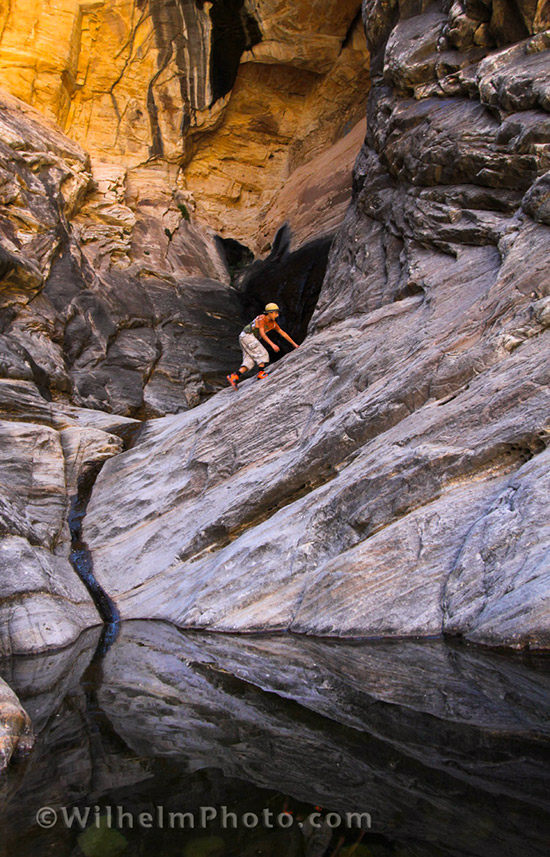
The joy of photography comes from following what you love and waiting for the elements of a good composition to come together.

The joy of photography comes from following what you love and waiting for the elements of a good composition to come together.
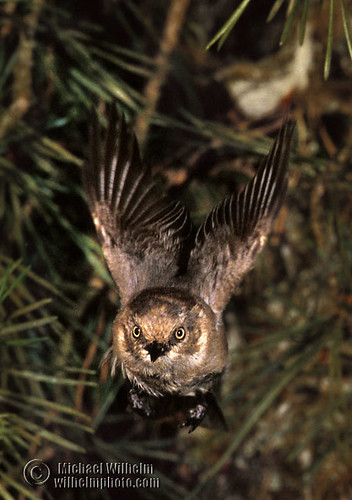
A female bushtit leaves her nest.
Little birds seldom stay in one place for long. They’re energetic, they flit, forage, hop, hover, and yes, they fly.
It’s a challenge to get a small bird, say a hummingbird or a chickadee, to stay in front of the camera long enough to focus and click. A telephoto lens helps to give a detailed look at the little guys, but this tunnel vision further compounds the problem of finding the bird in your frame. To succeed we need to know where the bird will be and have equipment poised for that fleeting moment when our subject takes the stage.
Sometimes a bird’s behavior will provide the opportunity to predict a good place to train your lens. In the spring males of some species will seek the highest perch in their territory to announce their presence to potential mates. A nest or food source will provide opportunities to observe a bird in a known location too. Birds often land on a favorite perch before proceeding to their nest or a feeder and this is a good place to catch them in a stately pose or even with a meal for their young. At home feeders you can provide a perfect perch for the birds and make sure you have the perfect angle and background for your pictures. Since you know where she’ll be going next maybe you can even catch that little speedster on the wing.
Planning is key to catching hyper little birds in camera, and when I’m out watching them I look for opportunities to get a step ahead of their next move.
msw
“F/11 and be there!” That’s an old photography expression to describe a subject so interesting or dramatic that merely recording the scene is enough to capture the interest of your audience. Nature offers intrinsic beauty and making nice pictures is often as simple as showing up when the light is good.
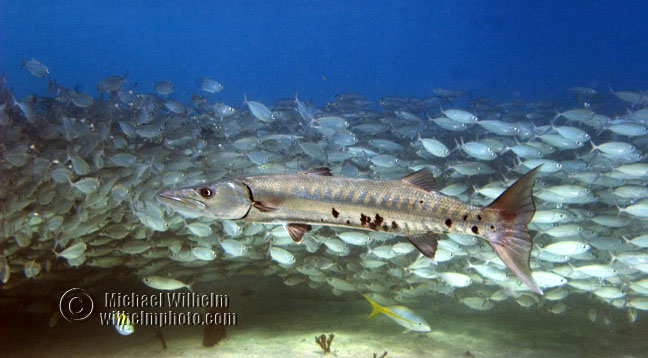
But nature can be fickle too; and, where wildlife is concered, downright unpredictable. On a recent trip to Mexico, I encountered a large school of jacks. While marveling at this “wall of fish” I soon noticed that I wasn’t the only one who was looking. A large barracuda was patroling the periphery of the school below me and seemed to be surveying the small fish like a hungry boy at a buffet. I quickly found the shutter release on my underwater housing and attempted to dive a few feet below the surface to line up a shot that would include both predator and prey. With a flick of its tail the barracuda disappeared into the murky blue ocean.
The next day I swam out to the channel and located the school of jacks. Sure enough, the barracuda was also in the vicinity. The wind had created choppy conditions that further hampered the under water visibility so I spent my time testing the comfort zone of the barracuda. For three more days, sometimes twice daily, I took my swim out to the jacks hoping to find the barracuda too and improved conditions for photography. Each time I was able to earn more trust and close the distance that the barracuda would allow.
One the fourth day the water was clear, the school of jacks were waiting and the barracuda seemed to regard me as some odd but harmless fish. When all of the elements (predator, prey, water quality and light) lined up I was ready. The result was worth the extra effort.
msw
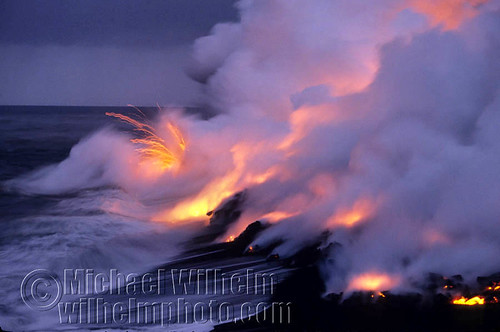
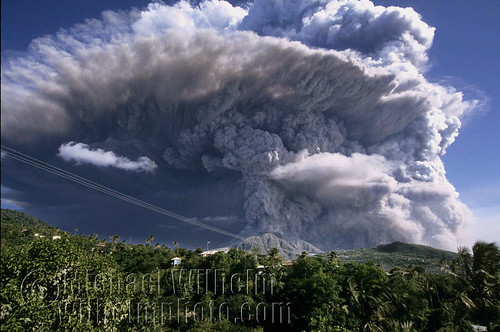
The question hadn’t occurred to me until I stood there watching molten rock from the volcano Kilauea, in Hawaii, flowing into the ocean. Lava, on occasion, explodes when it’s rapidly cooled by sea water sending tracers flying. But what makes magma (molten rock below the earth’s crust) flow out of shield volcanoes like Kilauea in spattering bursts and fluid rivers of lava (molten rock on the earth’s surface) while strato-volcanoes like Mt. St. Helens explode with such tremendous force?
In a word, the answer comes down to viscosity. As nature would have it, what makes magma fluid or thick and “gooey” comes down to a fairly complex cocktail including the chemical composition of the source rock, temperature and gas content. In Brief, low viscosity magmas flow more easily and allow gases to escape and the thick stuff can trap gases building pressure to the point that literally moves mountains. In either case, when magma reaches the earth’s surface it’s an awesome sight to behold.
Shortly after my observations at Kilauea I became aware of the Soufrierre Hills volcano that was devastating the carribean island Montserrat. I couldn’t resist the opportunity to witness an active shield and strato volcano within six months of each other.
In Hawaii the relatively fluid lava has been blanketing the slopes of Kilauea and adding land mass to the big island for centuries. People have been displaced from their homes and a new Park Service Visitor’s Center was leveled shortly after its completion. On Montserrat the capitol city of Plymouth was devastated by volcanic ash and the airport rendered nonexistent by a pyroclastic flow. Refugees crowded onto a corner of the island shielded by topography from the volcano’s wrath. The island felt very small indeed when a small eruptive event sent an ash plume 15,000 into the sky during my visit. What a difference a bit of viscosity can make!